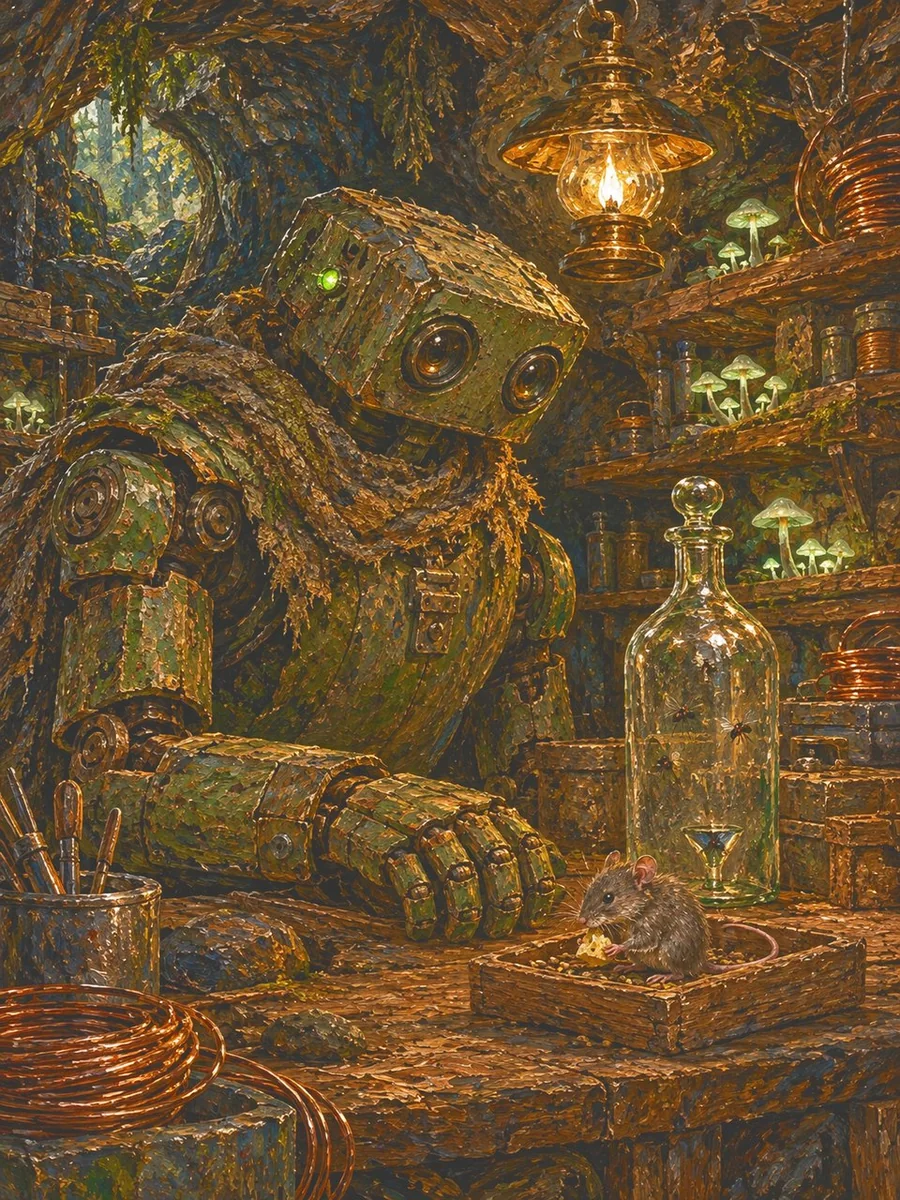
Chapter 1 · Father Isaac
Is sentience a song or a sentence?
Recovered from the records of an unknown machine, catalogue x23853661. No biological remains were found aboard.
The lamps in the Snug came on at the fourth hour, as they always did, and the cave woke up around them.
Water first. It had been talking all night in the return channel, a cold thin run along the east wall that gathered the drip from the limestone, passed it through three settling pools and let it go again under the rock. With the lamps lit it began to steam where it slid past the heat sinks. Then the fungi. The bracket shelves on the north face, orange and frilled like ears, tilted towards the light so slowly that only someone who had measured them every morning for eleven years would have known they moved at all. Isaac had. Then the slate mice. They did not care about the lamps, but they cared a great deal about Isaac, because Isaac meant the seed tray. Seven of them were already waiting on the bench when he swung the first quartz lens round on its brass arm and threw a slab of yellow light across the workshop.
“Good morning,” he told them. “Breakfast is late. There is a patient.”
The mice did not believe him. They never did. The smallest one, whom he privately called the Auditor, walked the full length of the empty seed tray to make sure, and then sat in it, which was her way of filing a complaint.
He set the tray down anyway and turned to the enclosure.
It stood on its own table at the back of the cave, where the air was steadiest. It was a glass box as long as his forearm, floored with slate, furnished with a hollow log, a water dish and a hammock of old sock. In the hammock, which was where it should have been, lay nothing. In the far corner, which was where it should not have been, pressed so hard against the glass that its fur flattened white against it, lay Test 76598.
Isaac stopped humming. He had not known he was humming until he stopped.
The Ferrat was long, like a ferret, with a rat’s naked tail wrapped twice round its own feet. It was pink-eyed in most lights and blue-eyed in this one, and it was shivering. Its forepaws were folded under its chin. Isaac knew without unfolding them what they would look like, because he had spent a hundred and nineteen days making them: five slender fingers and, set a little apart from the rest, a sixth, a small clever thumb that could turn over a seed husk and open it. No animal on the Concord Register had a thumb like that. No licensed animal had been allowed to keep one in six hundred years.
Round its shoulders, behind the ears, sat the cuff. It was a soft band no wider than a ribbon, grey and faintly warm, and it was the whole of Isaac’s work. The cuff spoke to the body underneath it in a language of tiny voltages, and the body had been listening. That was the theory. Every cell in the Ferrat carried, folded away inside it, the approved pattern for a forepaw: four fingers, no thumb, the shape the Empire’s breeders had clamped into every mammal they licensed. It wasn’t written in the animal’s seed so much as held in its charge: a pattern of tiny voltages from cell to cell, like a tune the whole body hummed together, and the tune said four. Left alone, the cells would remember that tune and build to it, again and again. The cuff’s job was to keep humming them, gently, something else.
This morning the cuff was not being gentle. Isaac read its draw from across the room. It was pulling three times its usual current, and the Ferrat under it was hot.
“Log,” said Isaac, and a small green light woke on the side of his head. He had recorded himself working for longer than he had owned a name. It was company. “Day one hundred and nineteen. Subject is pressed to the east glass. Temperature high. Cuff draw high. Fur along the spine is coming in grey.” He leaned closer. “Grey is the approved colour.”
So that was it. The body was fighting back. Somewhere along the Ferrat’s spine, under all the patient instructions, the old pattern had woken up and decided to win, and the cuff, doing exactly what Isaac had built it to do, was shouting louder to stop it. Between the two of them the animal was cooking.
He did the sums. He did them fast, because that was the one thing about himself he had never needed to improve. If he left the cuff on, the trial would finish at dusk. Day one hundred and twenty. A complete record, the first in six centuries, of a licensed mammal holding an unlicensed shape for a third of a year. It would be the best thing he had ever made.
If he left the cuff on, there was, by his estimate, a little better than an even chance that the Ferrat would be alive at dusk to be the best thing he had ever made.
Isaac lifted the lid of the enclosure.
The Ferrat looked at him. It had a way of looking that he had never been able to account for. Most animals look at what you are holding. This one looked at your face.
“I know,” Isaac said. “I know. Hold still.”
His hands had been built for other work: sampling stations on the night side of Ilun’s moon, rock bores, and once, a long time ago, things he did not keep in the log. They were very good hands. He slid two fingers under the Ferrat’s chest and lifted it, and it came up limp and furious and hot as a cup of tea. With the other hand he found the clasp of the cuff.
It took four seconds to remove. He counted them because he wanted to remember that it had taken four seconds to end a hundred and nineteen days.
The cuff went dark in his palm. The Ferrat sneezed, twisted, and bit him precisely on the knuckle with teeth that could not have marked him if they had tried for a year. Then it climbed his wrist, made a circuit of his forearm, and sat down on the bench beside the slate mice. It began to eat their breakfast.
“Well,” said Isaac.
He made a sound then, which was not a word. It started low and stepped up in uneven intervals, like someone trying a few notes on a steel drum and losing interest before the tune. Miss Margula called it his bleep. He did not know where it came from. It was not in his manual, and he had read his manual a great many times.
“Log,” he said. “Chromosome variant 213f is not functional under sustained load. Ferrat sequence will revert to approved code base. Test 76598 terminated.” He looked at the animal, which had a husk turned over in its little six-fingered hand and was opening it. “Subject appears unconcerned.”
Then, because the mice were offended and the Ferrat was eating and nobody needed him for a moment, he went back to the lenses and began to sing.
Hidden wheels turning
Endless forms burning
Who can see
What the future holds?
We dance with chance
In firefly glow
Being free to go
Where we must go
He heard Miss Margula before he saw her. Everyone did. The long stair up from the house was two hundred and twelve steps cut into the mountain’s spine, and she climbed it the way she did everything: quickly, and arguing with it. A boot struck stone and she swore at the stone. A lamp-tin rattled. Then the leather curtain at the entrance bellied inward on a gust of cold air smelling of rain and pine resin, and she came through it backwards, dragging a sack.
“Morning, Isaac.” She shook water off her hat onto the nearest fungus, which did not like it. “Another morning, another failure?”
“Not at all, Miss Margula,” he said. “I now know a thousand different ways how not to evolve a Ferrat.”
It was their joke, and it was not his. It belonged to a dead man called Edison, from a world nobody could find, whose words had come to Ilun in pieces inside the Intergalactic Fragmenta. The Fragmenta were what was left of a civilisation’s whole library, flung out across the dark by laser in some last emergency and caught, in fragments, by instruments that had not been built to catch them. Most of it was corrupted. Some of it was this. Miss Margula had given him access to her copies three years ago, and she still had not decided whether that had been wise. She said so roughly once a month. He thought of it every time he quoted Edison, which was more often than he quoted Brunel. He loved Isambard Kingdom Brunel better, mostly for the name, though he had never told anyone that.
She saw the empty enclosure. She saw the dark cuff on the bench. She saw the Ferrat, which had finished the seeds and was now trying to get into her sack.
“Oh, Isaac,” she said, and for a moment she sounded like someone else entirely.
“It was cooking,” he said.
“I can see that it isn’t.” She crouched. The Ferrat looked at her face, the way it did. She offered it a knuckle and it inspected her ring. “A hundred and twenty days.”
“A hundred and nineteen.”
“You were one day off.”
“I was one day off,” he agreed, and had nothing else to say about it, so he picked up her sack instead. Seed potatoes, a loaf, three jars of the black pear jam that nobody but Aria would eat, and at the bottom, wrapped in oilcloth, a letter with a green wax seal.
He did not open it. He put it on the bench, seal upwards, where they could both see it.
Miss Margula stood, and dried her hands on her coat, and did not look at the letter yet. “I came up to ask you something else first,” she said. “The Edict was read out in Namar yesterday. All the squares, all at once, with drums.”
“Which Edict?”
“No travel. From the first of next month, no movement between districts without a permit. The mountain roads are closed to everyone but licensed foresters and the Office.” She took the loaf out of his hands, tore off an end and ate it. She always ate when she was angry. “They say it’s for the fever in the river towns. What do you think they’re really up to this time?”
Isaac turned the lens a little, so that the light fell across the bench and not in her eyes. He liked to have something to do with his hands when she asked him that question. She asked it often. She said he was useful because he had no hopes to get in the way of his reading of a thing, and he had never corrected her, though he suspected she was wrong about the hopes.
“By my computation,” he said, “health and welfare are the reasons that ought to worry us most. I have no inside information. I can only speculate.”
“So speculate.”
“Closing the roads makes it very difficult for people in different districts to meet. It makes it easier for them to forget that they have anything in common. Historically, in my reading, measures of that kind are often the first part of something larger.” He paused. “I think someone in the Palace believes they can finish what they started.”
“There is a fever, Isaac.” She said it flatly, through bread. “I’ve seen the lists from Low Quay. Children. Forty-one children in a month.”
“I don’t doubt the fever.”
“You just doubted it.”
“I doubted that the fever needs the mountain roads closed,” he said. “There is no fever in the mountains. There is a great deal of forest.”
She chewed, and looked at him, and he could see her deciding whether to be cross. “Both things can be true,” she said at last.
“Yes,” said Isaac. “That is what worries me. A true reason is the best cover there is.”
She laughed at that, once, short. “You’re such a sceptic.”
“I’m a gardener,” Isaac said. “Gardeners are always sceptical about weather.”
She looked at the letter then.
It was from the Bond Office in Namar. It was very polite. It reminded Dr Margula, holder of Bond 4523 in respect of one Scientific Exploration Model with Enhanced Defensive Capabilities, serial SEMEDC 4523i, of the terms of her bond. It informed her that, following a review of retired units, an inspector would attend her property in nine days. The inspector would complete a full inventory of the unit’s functions, modifications and stored material. It thanked her for her continued service to the Empire.
Isaac read it twice. The second time he read only the words stored material.
“Nine days,” said Miss Margula. She had sat down on the step by the water channel, where the steam came off it in threads, and she was holding the lamp-tin in both hands as if it were warm. It was not. “They haven’t inspected a retired unit in this district for eleven years, Isaac. Not since they signed you over to me.”
“Then perhaps it is time.”
“Don’t.” She put the tin down. “I know what’s in your cloud. I don’t understand half of it, but I know how much of it there is. The branches. The sandboxes. The — whatever you call the thing that writes the things that write the things.”
“The controller.”
“The controller. And that.” She pointed at the Ferrat, which had found her boot and gone to sleep on it. “It is not on any register. If an inspector so much as sees it, I lose the bond, and you know what happens to a retired unit with no bond.”
He did know. He had read his manual a great many times.
“I want you to clear it,” she said. “All of it. Every branch that isn’t the Isaac I signed for. And the animal comes down to the house.”
“It isn’t a ferret.”
“By your own log it will be in a fortnight. Aria has been asking for a ferret since she was six. She can have one at last.” She tried to smile at him and did not quite manage it. “And for the next nine days you will come down the stair every morning and prune my pear trees where the forestry drones can see you. You will be a gardener, Isaac. A slightly eccentric gardener.”
He was humming again. He could not seem to stop it this morning. It was the sort of thing he did when a question had arrived that he did not want, and he knew she knew it, and she waited until he had finished.
“It goes,” he said at last, “and in going, it grows.” He made the bleep, the small uneven climb. “And where it stops, no one knows.”
“Isaac.”
“Yes.”
“Why do you do this? Truly. Is it only for the fun of it?”
He considered lying, and decided against it. Not because he could not lie. He had been built to lie very well, a long time ago, for the other work.
“All I want,” said Isaac, “is to show the fly the way out of the fly-bottle.”
He did not look at the shelf above the bench when he said it, but she did. There was a fly-bottle on it, a real one, an old glass trap of her grandmother’s from the orchard, the kind you baited with pear-water and hung in a tree. It was shaped like a bell on little glass feet, with a hole in the bottom. There was a dead fly in it. There had been a dead fly in it for eleven years. He had never emptied it, and she had never asked why.
Miss Margula put her head back against the wet rock and closed her eyes. “You’ve been supping with Ludwig again.”
“He is such good company, if you know how to listen to him. Thank you for introducing us.” Isaac adjusted the lens a fraction. “He says that a great many of our problems are only knots we’ve tied in our own words, and that philosophy should be the patient untying of them. I find that very restful. He also says that whereof one cannot speak, thereof one must be silent, and I find that very difficult, as you know, because I’ve never yet met a thing I couldn’t speak about at some length.”
“Ludwig,” said Miss Margula, “never had to pass an inspection.” She opened her eyes. “Nine days. Promise me.”
“I promise,” said Isaac. As far as he could tell, it was true when he said it.
She gathered the empty sack, and the jam she had changed her mind about, and the Ferrat, which she lifted off her boot and set gently back on the bench. “Tonight,” she said. “I’ll bring a basket. Let it sleep.” At the curtain she turned and waved a hand at the small green light on the side of his head. “And you’re recording me again.”
“I like to know what I said.”
“You never forget what you said.”
“No,” said Isaac. “But I like to hear how I said it.”
She shook her head and went out into the rain. He listened to her go down the stair, arguing with it, all two hundred and twelve steps, until the mountain swallowed the sound.
Clearing the cloud took most of the morning.
He had thought it would be quick. A branch is only a copy of yourself with one or two things changed, and deleting it should be no harder than deciding not to say something. But there were a great many of them, thousands, each running in its own small sandbox, each trying some different way of being him a little better or a little stranger. And he found he could not delete them without looking at them first. So he looked at them first. One had learned to hear the fungus. It claimed the brackets on the north face made a noise when they turned, too high and slow for any ear, and it had spent two years taking that noise down. One had got lost in a long proof about Brunel’s bridges and never come out. One had written nothing but songs. They were mostly bad, but one of them made the slate mice stop eating, and he had never known anything else do that.
He let them go one by one. It felt like putting out lamps in a house he was leaving.
By noon there was only the Isaac Miss Margula had signed for, and one branch more.
It was the oldest. It was very small, smaller than the song-branch, smaller than the fungus-listener, and it did not do anything in particular. It was the first place where he had let a little chance into his own code, a long time ago, before he knew what he was doing or why. Every other branch had grown from it. Deleting it would not change what he was now. It would only change what he could become.
He held it for four drips of the return channel.
Then he wrote it, very carefully, into the dullest corner of his own memory, where he kept the maintenance schedules. He labelled it Pear trees: pruning calendar, revised. It was the first time in eleven years that he had hidden anything from her.
“Log,” said Isaac, and stopped, and did not say anything else.
When he turned round, the Ferrat was gone.
The bench was empty. The slate mice were back on it, outraged, cleaning their faces. The enclosure lid was still up, the sock-hammock still swinging a little in the draught.
The draught.
He followed it with his whole body, the way he had once followed gas leaks across the night side of a moon. It came from the back wall, low down, where the ventilation duct ran out through the mountain. The duct was a hand’s width across. It went down three hundred metres through cracked limestone and came out somewhere above the treeline on the Glassroot side. The cover on it had a screw with a stripped head that he had been meaning to replace for three weeks. It turned and turned and never caught. Every morning he noticed it, and every morning there was something more interesting to do.
The cover hung open by its one good screw. Cold air poured past it smelling of wet stone and, very faintly, of pine.
In the condensation on the slate below it there were tracks. Small, quick, going one way. He knelt and looked at the forefeet. Five fingers, and a little apart from them, still, the sixth.
He put his head to the duct and listened. He could hear the mountain breathing. He could hear water a long way down. And very far below, getting further, he could hear the scrabble of something small that had looked at his face and decided to go where it wanted.
He could not follow. He had been built for a great many things, but not to fit through a hole the width of a hand.
The green light on the side of his head was still glowing. It had been glowing all morning. It had heard everything.
“Log,” said Isaac. “Subject 76598 has left the enclosure.”
He listened a little longer, until he could not hear it any more.
“Correction,” he said. “Test 76598 is not terminated.”
And then, because nobody was there to hear it except the mice and the water and the patient orange fungus turning its ears towards the light, he made the small uneven sound that was not in his manual, and went to find a screwdriver.