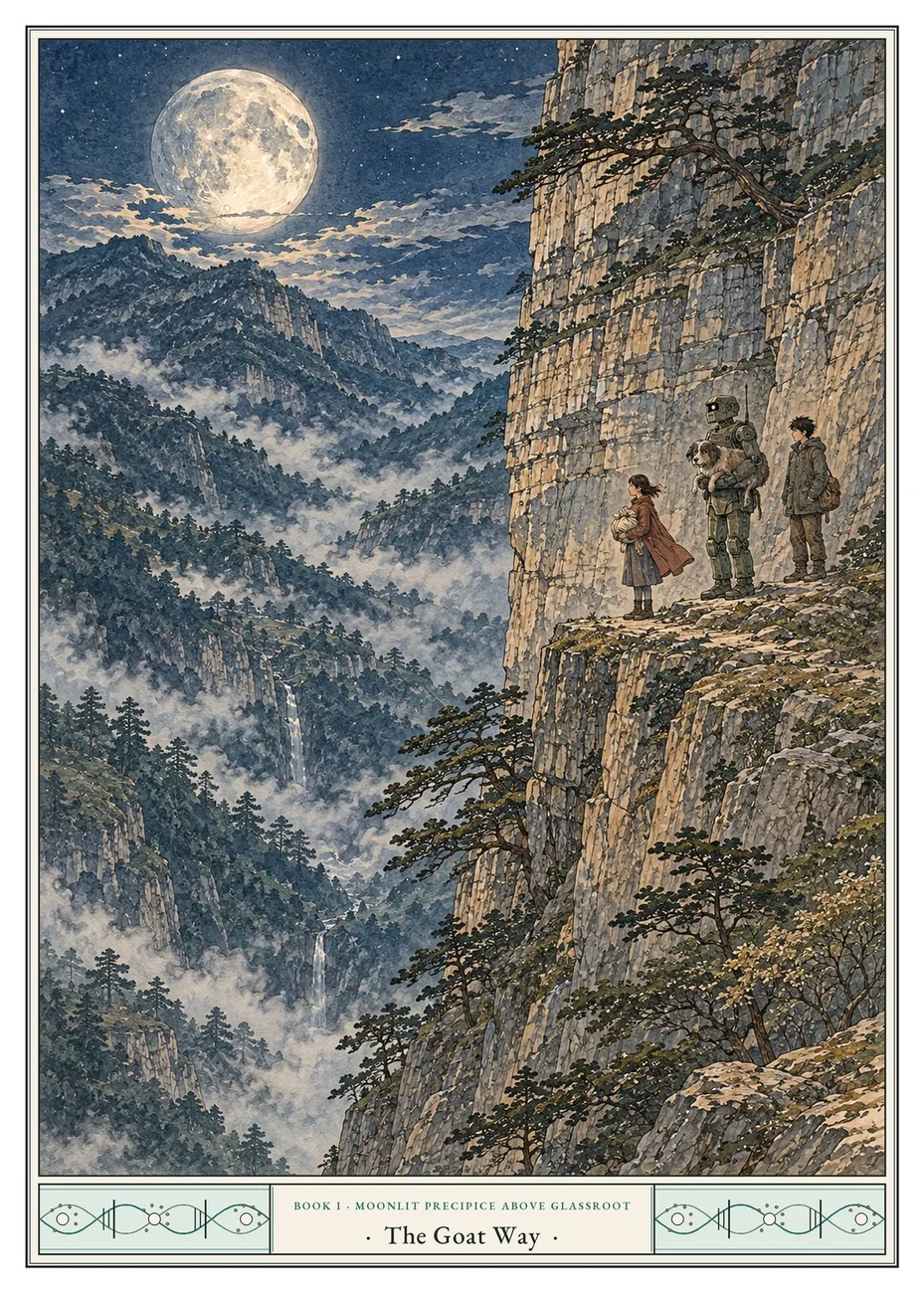
A Mountain That Breathes
In 1881, so the story goes, two brothers named Tom and Jesse Bingham heard a whistling in the hills of South Dakota and found it coming from a hole in the rock no bigger than a dinner plate. Air was rushing out of it so hard that it knocked Tom’s hat off. When they came back days later, the wind was blowing in. The cave beneath is now Wind Cave National Park, and the Lakota have long called the place something like “breathing earth”.1
The physics is pleasingly simple. A big cave system holds a huge volume of air that stays close to the rock’s year-round temperature. When the weather outside brings falling air pressure, the cave breathes out; when pressure rises, it breathes in. Temperature does the rest. In winter, warm cave air is lighter than the freezing air outside, so it rises out of high openings and pulls cold air in at low ones. In summer the flow reverses. Cavers call it the chimney effect, and a deep enough cave can run it like a stove.2
Shienshan’s Breathing Stone is a mountain doing exactly this. The Snug hidden inside it stays warm through the winter for the same reason a real cave does, and the steam that pours from its mouth is the mountain exhaling. Book I’s final chapter is named after it, and by then you will know why a breathing mountain makes a better hiding place than a sealed one, and a worse one.
Foxfire, Submarines & an Honest Argument
Walk through an old wet wood at night and you may see a faint green glow in rotting logs. Country people called it foxfire. In 1775 the American inventor David Bushnell used it to light the depth gauge and compass inside the Turtle, a one-man wooden submarine, because a candle would have used up the air. Benjamin Franklin had been consulted about how to light the dials. More than a hundred kinds of fungus glow like this, using a chemical reaction that, in at least one species, follows a daily clock.3
Underground, fungal threads wrap round tree roots, swapping water and minerals for the trees’ sugar. In 1997 Suzanne Simard and colleagues showed carbon moving between birch and fir trees through these fungal connections.4 The idea grew into the “wood-wide web”: forests where mother trees feed their seedlings and warn their neighbours. It became wildly popular. In 2023 a group of forest scientists published a careful warning that many popular claims had run well ahead of the evidence, and that some studies were being cited for more than they had shown.5
That argument is good science in action, and worth watching. The fungal networks are real. How much they do, and how purposefully, is still being argued over with evidence. Glassroot’s old beeches and their mossy roots in Book I are written in that spirit. The forest is alive and full of signals, and the people who listen to it best are the ones who keep asking how they know.
Stone Grown From Hot Water (Book IV context: the southern geothermal terraces and the gas that pools in low ground)
Stone Grown From Hot Water
When hot water rich in dissolved silica rises through rock and cools near the surface, the silica drops out to form a soft, glassy stone called sinter. Over centuries it builds terraces of shallow pools, each rim grown a little higher than the last. The most famous were New Zealand’s Pink and White Terraces, painted and photographed by Victorian tourists, until the Tarawera eruption of 1886 buried them in a single night. Geologists prize sinter because it fossilises microbes in astonishing detail, and some of the oldest signs of life on land, around 3.5 billion years old, come from ancient hot-spring stone in Western Australia.6
Hot springs have changed your life already, even if you have never seen one. In the 1960s the microbiologist Thomas Brock found a bacterium living happily in near-boiling pools at Yellowstone and named it Thermus aquaticus. One of its enzymes does not fall apart in heat, and in the 1980s it became the engine of PCR, the method that copies DNA millions of times over. Every PCR test, from crime labs to the swab tests of the pandemic years, owes something to a puddle most people would walk past.
Low ground has a darker chemistry too. When a lot of life dies at once in waterlogged soil, bacteria that do not need oxygen get to work and release hydrogen sulphide. It smells of rotten eggs at tiny concentrations, but at dangerous levels it numbs the sense of smell, so the warning disappears just when you need it most. Because the gas is heavier than air, it pools in hollows. On Carthago in Book IV, knowing which way the air moves, and where to sleep, becomes a matter of life and death.
The Forests That Died of Being Tidy (Books III–V context: Hollen’s eleven cracks on the headland)
The Forests That Died of Being Tidy
In the eighteenth century, German state foresters wanted woods they could count. They cleared tangled forests and replanted them with straight rows of a single fast-growing species, all the same age. From a tax office the new forests looked perfect. The first harvest was superb. The second generation sickened in exhausted soil, and the rows blew down together in storms. The political scientist James C. Scott opens Seeing Like a State (1998) with this story, because it shows what happens when the people in charge prefer what is easy to measure to what is alive.7
The Register’s neat, licensed rows in Book I belong to that way of seeing, and Carthago tests it hard. On the new world, a single fast crop sown in straight lines comes up astonishingly quickly, and the series lets you guess how well that is going to end. What lasts is slower and less tidy. Hollen, a fitter from the net lofts of Namar, works the headland with his own thumbs, crack by crack, while everybody thinks he has lost his mind. By Book V the whole colony is kneeling in the cold doing the same, and Margula has to talk Nefer out of making every dent the same depth.
Primary Sources & Scholarly References (Hover or tap superscripts inline to preview)
- U.S. National Park Service, What Causes the Wind of Wind Cave.
- Derek Ford and Paul Williams, Karst Hydrogeology and Geomorphology (Chichester: Wiley, 2007), Wiley.
- Anderson G. Oliveira et al., “Circadian Control Sheds Light on Fungal Bioluminescence”, Current Biology 25:7 (2015), 964–968, Current Biology.
- Suzanne W. Simard et al., “Net transfer of carbon between ectomycorrhizal tree species in the field”, Nature 388 (1997), 579–582, Nature.
- Justine Karst, Melanie D. Jones and Jason D. Hoeksema, “Positive citation bias and overinterpreted results lead to misinformation on common mycorrhizal networks in forests”, Nature Ecology & Evolution 7 (2023), 501–511, Nature Ecology & Evolution.
- Kathleen A. Campbell et al., “Tracing Biosignature Preservation of Geothermally Silicified Microbial Textures into the Geological Record”, Astrobiology 15:10 (2015), 858–882, doi:10.1089/ast.2015.1307; Tara Djokic et al., “Earliest signs of life on land preserved in ca. 3.5 Gyr-old hot spring deposits”, Nature Communications 8 (2017), 15263, Nature Communications.
- James C. Scott, Seeing Like a State: How Certain Schemes to Improve the Human Condition Have Failed (New Haven: Yale University Press, 1998), Chapter 1, Yale University Press.