
Chapter 2 · The Exemption
Ben ran the Low Quay stair with his pass in his teeth.
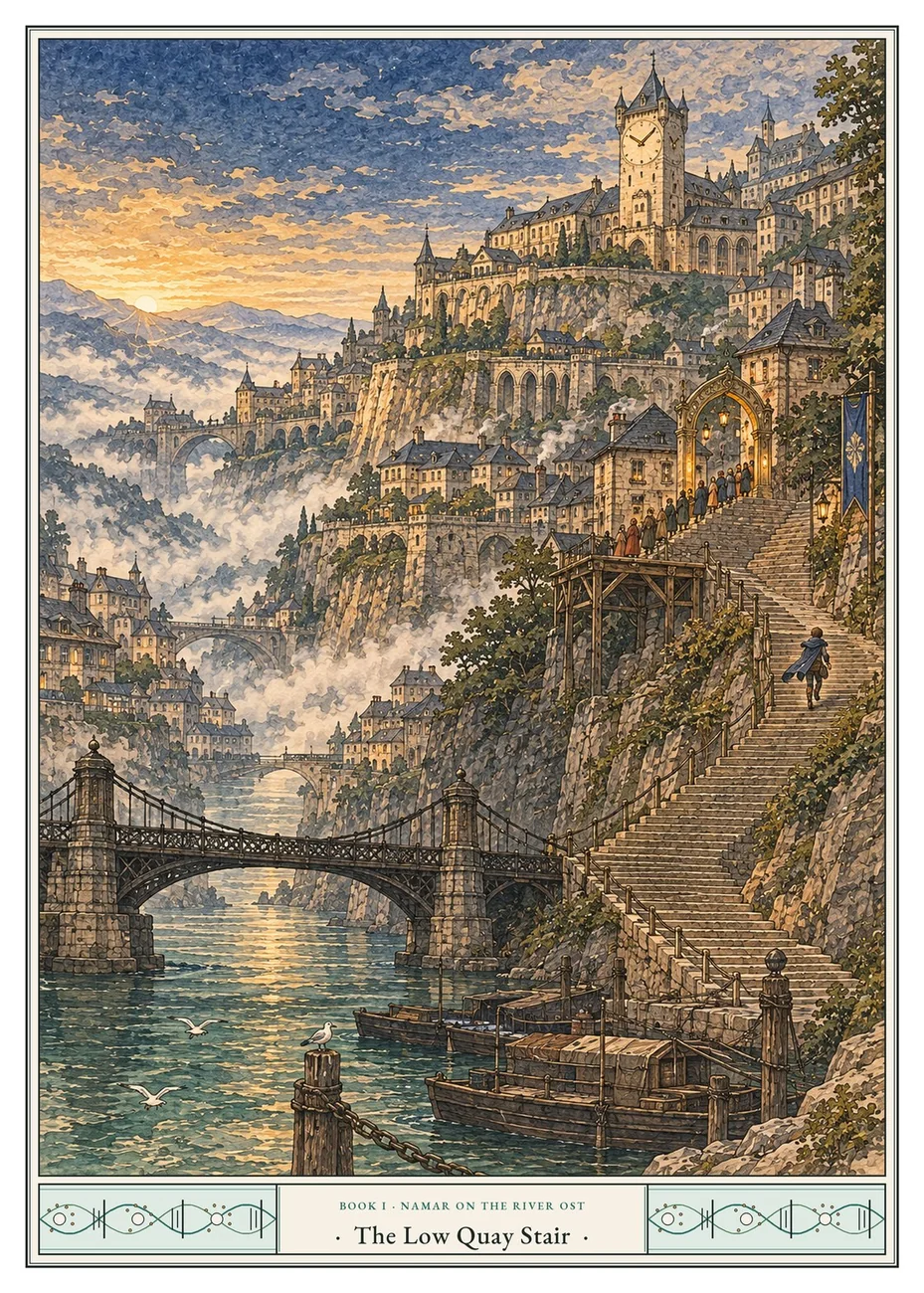
The clip had snapped on the tram, somewhere between the fish market and the chain bridge. There was nowhere to put the pass but his mouth, because both his hands were busy: one on his satchel strap, one on the rail. He needed the rail. The Low Quay stair was three hundred and four steps from the river to the Crown terrace, the rail was slick with fog, and he was taking the steps two at a time. The fog came up the stair with him. It smelled of tar and wet rope and the coal smoke of every breakfast in the river district. Somewhere below, a barge horn complained at the morning, and the gulls answered.
At the half-landing a queue stopped him.
It had not been there in the summer. Now there was a booth of green-painted planks, two guards in fever masks and an arch: a hoop of brass taller than a man, humming to itself, with a strip of glass along the top that lit white or amber as each person passed under it. A painted sign said TEMPERATURE SCREENING BY ORDER — RIVER DISTRICTS. Beside the arch a rope marked off a second lane, which was empty, and a smaller sign said OFFICE AND CROWN.
Ben counted the queue out of habit. Forty-three. Clerks with ledgers under their arms. A woman with a basket of live eels, which were trying to leave. Two Academy scholars in the brown coats of the bursary. And at the very front, bent over with her hands on her knees, Kesh Ambo from his year.
Kesh lived in Low Quay. Ben knew that because she was the only person in their year who arrived at the Academy already tired, and because twice a week she stayed behind after drill to sweep the Hall of Instruments, which was how her bursary got paid. She was the best in the year at field sums. Ben was second. He minded more than he admitted.
She straightened up and walked under the arch. The glass went amber. The guard glanced at her wrists, where the running had brought up a flush, and then back at the glass.
“Step aside, miss,” he said. He said it kindly. “Second reading in ten minutes. Sit in the shade.”
“I ran,” said Kesh. “I ran up the stair, that’s all it is. Feel.” She held out her wrist.
“Ten minutes, miss. Rules.”
Above the fog Ben could see the Crown clock on the Academy tower, its gold hands smudged by mist. The eighth bell was six minutes off. The assessment began on the eighth bell, and the doors closed on it.
The guard at the empty lane had already seen Ben’s pass, wet and silver between his teeth, with the grey seal of the Office of the Biosphere and his parents’ names under it. He was lifting the rope.
Ben took the pass out of his mouth and wiped it on his coat.
“Come on through, sir,” the guard said. Sir. Ben was fourteen.
Kesh had sat down on the bench in the shade with her hands between her knees. She looked at the rope, and at the silver pass, and at him. She picked at a splinter in the bench.
“It says holder and party,” Ben said. He held the pass out to her, wet side up. “You could be party.”
“Party’s family.” She didn’t look at it again. “If I go under there warm and it is a fever, it’s your mam’s number on the sheet. She gets a letter. I get a week in the Ward, and somebody else sweeps the Hall, and the bursary goes with the broom.” She went back to the splinter. “Go on, then. One of us should get marked.”
“I’ll tell Pallis,” Ben said. “I’ll tell him it was the stair.”
“Tell him what? That the arch can’t do sums?” She dug in her coat and came out with a pencil stub, sharpened to a wicked point by something that was certainly not a pencil-knife, and wrote on the back of her own hand without looking. “Three hundred and four steps in four minutes and twenty. You run that, your blood’s a degree and a half hotter than it was at the bottom, fever or no fever. It’s your legs burning the breakfast. Anybody’s would.” She held the hand up so he could read it, small square figures in a row along the knuckles. “Tell him that. He likes a number. He likes it better when it’s his.”
“That’s not bad working,” Ben said, before he could stop himself.
“It’s very good working,” said Kesh. “It’s just on the wrong side of a rope.”
He thought afterwards that there must have been something to say. Some sentence would have made it fair, or at least made it his decision and not the rope’s. He looked for that sentence all through the assessment and never found it. What he did, there on the half-landing, was step over the line on the flagstones where the Office lane began. The guard let the rope fall behind him with a soft slap. Ben went up the last hundred and fifty steps alone, very fast, as if that would help.
The Hall of Instruments had a glass roof, and on clear days the light came down through it like water through a sieve, laying bright squares across the benches. Today the fog had come up the hill and sat on the glass. Everything was grey and close and smelled of brass polish and lamp oil, and of forty cadets who had all run up stairs.
Examiner Pallis stood at the front with a pencil, tapping it against his teeth. It was his only habit. Cadets did impressions of it in the dormitories.
“Three cores,” he said. “From Office collections. Determine which comes from ground fit for licensed clearance, and show your working. You have until the tenth bell. Begin.”
Each bench held three glass tubes in a wooden rack, each as long as a forearm and packed with soil, each labelled in a clerk’s copperplate. Sector 4, Low Fen. Sector 9, Glassroot North. Sector 12, Ost Meadows. Under each label was the Office’s own classification, which was most of the answer: you looked it up in the tables, ran the sums and showed you had understood why. Sector 9 was marked Biomass: nil. Condition: exhausted.
Ben did the sums. Then he did what he always did, which was to look at the thing itself.
He held the Sector 9 tube up to the grey light and turned it. The soil was dark at the top and pale lower down, banded like a cut cake. Near the top, pressed against the glass, was a tangle of root hairs, finer than thread and almost white. Beside them, a smear of something like cotton: fungus, the kind that runs through soil in webs. White, not brown. Ben knew from his mother’s kitchen table, from years of listening to her talk at supper, that dead root hairs go brown in days. White meant something had been alive in that soil not long ago. Weeks, maybe less.
He sat with the tube in his hands while the cadet behind him sharpened a pencil, slowly, in long angry strokes.
The label was the Office’s. The Office was the Office. The Academy had chosen these cores, labelled them and set them out for forty cadets. If there were a mistake, someone would have seen it. Probably the root hairs were from some other plant that stayed white when it died. Probably there was a table for that too, and he hadn’t reached it yet. Probably.
He wrote Sector 9 and showed his working from the tables, neatly. It was, he thought, the cleanest working he had ever done.
At the tenth bell Pallis walked the benches. While he was still two benches off, Ben put the Sector 9 tube back in its rack and turned it with one finger, a quarter turn and a little more, until the white root hairs faced the wall and the side towards the aisle showed nothing but soil, banded dark and pale. Nobody had asked him to. Pallis stopped at Ben’s and read it, the pencil going tap, tap against his teeth, and then he put the pencil down.
“Excellent result, cadet,” he said. “Clean working. Your mother will be pleased.”
Ben said, “Thank you, sir.” He felt warm all through. His finger was still on the rim of the rack. He took it off, and pulled his cuffs down over his wrists without quite knowing why.
“You look,” said Alex Verran, sliding along the bench to him as the hall emptied, “like a cadet who has just been told he’s excellent and is trying to work out what it cost. Which is a look I know well. My father says it’s the face of a man who will one day be very senior and very tired.” He tipped his own rack of cores and peered into them as if they might confess something. “I wrote Sector 9 as well, by the way, though I’m fairly sure I got there by a route Pallis would have me shot for. Where’s Kesh?”
Alex was fourteen, nearly fifteen, a head taller than Ben and all elbows. He had ink on every finger of his left hand, though Ben had never seen him write anything except notes passed in class. He was Ben’s best friend, which no one at the Academy could quite understand, including, sometimes, Ben.
“Stuck at the stair,” Ben said. “The fever arch. She ran up and it went amber.”
“Ah.” Alex looked at the empty bench by the window, where Kesh always sat because the light was better there. Then at Pallis, who was packing the cores into their crate. “Ah,” he said again, more thoughtfully. “Stay here.”
Ben watched him go. Alex talked to Pallis while the cores went into the crate one by one. His hands moved the whole while, sketching shapes in the air: the stair, a set of scales, something that might have been a bridge. At one point Pallis laughed, a sudden bark, and then looked surprised at himself. Alex came back with his hands in his pockets.
“Resit tomorrow at the fourth bell,” he said. “Small hall. Unsupervised, which is to say supervised by me, because I volunteered, because I’m a saint. Don’t look at me like that. Pallis’s brother owes my father nine hundred crowns from cards, and has done since the spring. My father has been very gracious about it, which is to say he hasn’t mentioned it, which is to say everyone knows. So I mentioned it, very gently, in a way that didn’t mention it at all. Now Kesh gets her marks, and Pallis thinks I’m a charming young man with a future, and my father will want to know why I spent a nine-hundred-crown silence on a girl from Low Quay. So I have done a good deed and run up a debt in the same breath, which my father says is the whole of politics.”
“I should have waited with her,” Ben said.
“And then there’d be two of you failing, and I’d have had to talk twice as long.” Alex knocked his shoulder against Ben’s. “You did the sensible thing, Benno. That’s what you’re for. I do the other thing.”
Ben laughed, because Alex wanted him to. The stone in his shoe stayed where it was.
The Bell terrace ran along the hill above the Academy. Its houses were tall and narrow and leaned against each other like books on a shelf. Ben’s was the ox-blood one with a small brass bell over the door that had not rung since before he was born. Inside it was five floors of stairs and, on every landing, his father’s clocks.
Tavin mended clocks. He did not sell them, or wind them to the same time, or let anyone else touch them. So the house was full of ticking, and on the hour the clocks struck the hour one after another, a long untidy argument that rolled up and down the stairwell for most of a minute. Ben had grown up thinking all houses sounded like that. He had been eight before he realised that other people’s houses had silence in them.
He climbed with his mark in his head, held level, like a full ladle. Excellent result. He wanted to say it to his mother. He wanted to see her face when he did, and he didn’t let himself wonder why he also didn’t.
The door to the office on the second floor was half open. Voices came through it.
“I walked it in the spring, Tavin,” said his mother. “I walked every chain of it. There were drummers nesting in the beeches. I counted eleven pairs.”
“I know you did, love.”
“Then why are we even talking about this?”
A pause. One of the clocks on the landing ticked louder than the others. Ben had never noticed that before.
“Because they asked nicely,” said his father. “And they won’t ask twice.”
“Then let them put my number on it themselves.”
“They already have.” Tavin’s voice was very gentle, the way it went when he was holding a part too small to see. “That’s what this is, Mara. They only want the signature under it.”
Ben pushed the door.
The office was maps. Maps on the walls and maps on the floor, the Glassroot and the Ost Meadows and the Low Fen in a hundred greens and browns, with the survey chains coiled on hooks by the window like sleeping brass snakes. His father was at the bench with a clock opened up in front of him and its wheels laid out in a careful line. His mother was at the table eating an apple. She ate apples the way she did everything, entirely: core, pips, the little woody stalk. She said the Register wasted enough without her helping.
They both stopped talking.
“Ben!” said his father. “How did it go?”
“Top mark.”
“Of course it was,” said his mother. She smiled at him, a real smile, quick and sharp, and then she looked at his hair. “They’ve cut it again.”
“It’s regulation.”
“It’s a hedge. They’ve topiaried you.” She took another bite. “Come out with me on the rest day. Glassroot, before they shut the mountain roads. I need a chain-holder who can count past eleven.”
“I’ve got drill.”
“It’s a rest day.”
“There’s extra drill. For the parade.”
“There’s always extra drill.”
“Mara,” said his father.
“I’m only asking him.” She looked at Ben with her head on one side. It was the look she gave a patch of ground she hadn’t made her mind up about. “You used to like the chain.”
“I’ll think about it,” Ben said.
“That,” said his mother, “is the Academy talking.”
He opened his mouth to say something unfair, and while it was open he saw the sheet on the table.
It was a map of Glassroot North, printed, not drawn. That was the first wrong thing, because his mother drew everything. In the middle was a block boxed in red, labelled Sector 9. Across it, in Office type: BIOMASS: NIL. CONDITION: EXHAUSTED. APPROVED FOR LICENSED CLEARANCE. In the bottom corner was a small stamped number: M-4471.
He knew the number. It was stamped on the brass handle of every chain on the wall. It was his mother’s.
Sector 9. White root hairs, white as cotton, pressed against the glass.
His mother turned the sheet face down and set her apple core on it, very precisely, in the middle.
Ben asked it anyway. It was the question nobody in the room had asked, and he could feel that they hadn’t, the way you feel a missing step in the dark.
“Are you going to sign it?”
On the landing a clock struck four, though it was nearly six. Another answered it, then another, all the way up the stairs, every one of them wrong in its own way, until the house was full of the sound.
“Wash your hands,” said his mother. “Supper.”