The Lily Horn
An uncollected Hollow Ford vignette set two summers before Book One. Published exclusively in the Great Deviants Companion Archive; not included in print or eBook editions.
The two drummers started at once, and that was the whole trouble.
Aria had the brass box open on the flat rock at the bend of the Long Path, where the stream first came up through the trees, and she had been sitting beside it since the orchard was grey. Margula’s field phonograph was the size of a bread crock and heavier than it looked, with a winding key on its flank and a wax cylinder behind a little door. The rule for it was the rule for the bees. Slowly. Twenty-four clicks gave you four minutes of wax. Twenty-eight was the stop, and Margula said twenty-eight in the voice she kept for adders.
Then a drummer began on a dead limb above the path, three hollow knocks with a trip in the middle, and three again. Before it had finished, another answered from further up the slope in the same three, faster and sharper, as if the first had got it wrong and somebody had to say so.
They were arguing. In two months of sitting on stones for Margula she had never heard drummers argue, and the box was not wound.
She wound it fast. Twelve. Sixteen. Up the hill the birds went at each other. Twenty. She had stopped counting, she was listening, and the key went round under her fingers with a smooth, greasy ease, and then with no ease at all.
Inside the box something tore, like a strip of tin pulled off a roof. Then a whirr, climbing. Then a long loose rattle, and nothing.
Uphill, both drummers had stopped to listen.
Bracken got up with one ear standing and the other folded inside out from lying on it, and looked at the box the way he looked at anyone who dropped a plate.
She got the back plate off with her thumbnail. The governor sat at the top of the train: a brass barrel no longer than her finger, a little wheel of thirty teeth and the pawl that rode them, click by click, so the spring could only let go at the speed of a person thinking. Seven of the teeth lay in the bottom of the box among the walnut dust, bright as fish scales. The pawl was on its side with its nose bent.
She put the plate back and shut the lid and sat with both hands on top of it, as if it might get out.
On Thursday Margula sent her down to Hollow Ford, which was ordinary, and which was the only reason Aria had slept.
Every few weeks Isaac finished a sackful of Mother Sallow’s clocks in the pear loft and somebody walked it two hours down the forest road. Margula went when her knee let her. This summer it mostly didn’t.
“Salt eels,” said Margula, at the range, with a wooden spoon standing in the porridge like an oar. “From the woman with the blue tubs. Not the man with the brown ones, because the man with the brown ones salts on a Wednesday and tells you it was Tuesday, and a Wednesday eel walked up two hours of forest road in July isn’t an eel by the time it gets here. It’s an argument, and I’m too old to have arguments for supper. Two pounds. Wrapped twice. She’ll wrap them three times and charge you for the paper.”
“Yes, Margula.”
The governor was in her coat pocket in a handkerchief, with Margula’s smallest screwdriver, borrowed out of the dresser drawer on Tuesday night by candle. The bond lived on the same dresser in a brown card folder with the Office seal on the flap. Aria had never needed to open it to know what it said. The holder’s name. The unit. The dog. Under the dog, in a clerk’s square hand, her.
She had been eating black-pear jam off a spoon when she took the governor out. She had not thought about that at the time.
Isaac was at the hives when she went through the orchard, down the long rows where the grey shoulder of Shienshan stood over everything. He held the lid of the nearest skep while bees walked on his five blunt metal fingers as if he were a gatepost, and he was singing Hidden wheels turning to them under his breath. The small green light at his temple was on. It was always on. Aria had asked him once what it was for, and he had said, Keeping me company, which seemed the kind of thing a garden unit would say.
“Three clocks,” Isaac said, without turning round. “The mantel clock is cured of its cough. The carriage clock strikes thirteen on Sundays, and I have decided to let it.” He made his sound then, the one that wasn’t a word, three notes climbing at odd widths and giving up before the top, and went back to the bees.
The forest road went down from Glassroot under oak and then beech and then alder where the ground got wet. Somewhere in the first mile a dry oat-husk got into her left boot. The boots were last summer’s and she wore them without socks because her toes had outgrown them, and the husk worked itself under her bare heel and stayed there, a small sharp argument she couldn’t reach without unlacing to the toe. By the second mile she had decided it lived there.
At the bottom the trees opened on the Ost, broad and slow over its grey stones, with the chapel on the far bank, black-timbered and low and four hundred years old. In July you could cross on the stepping-stones and wet only one foot; the bridge upstream was for carts. Bracken took the stones one at a time with his four toes spread, testing each like a man trying ice, and stopped on the middle one to bite the water and be outraged by it.
The market had filled the square already. Eels slid over one another in their tubs with a sound like wet rope. Cheeses sweated in muslin on a trestle, each in a little puddle of its own. A man was frying oatcakes in bacon fat over a brazier, and the smoke came across the square low and blue and got into everybody’s coat. Along the chapel wall second-hand boots stood in pairs on blankets, laces knotted together so nobody could walk off in one.
On the chapel porch the carved hands waited in the black oak, one each side of the door, polished chestnut-dark by centuries of people going past. Aria slapped the right one for luck, as she had since she was small, and her fingers skidded off the grooves the way they always did, six channels where a hand wanted five. Four hundred years ago somebody in Hollow Ford had been bad at hands.
Mother Sallow’s stall was at the back, under the yew, where the shade was deepest. On a board on nails hung every gauge of copper wire in the world, each wound tight on its own nail like a lacemaker’s bobbin, so the board shone in the dark of the yew in a dozen shades of orange. There were brass wheels sorted into egg boxes by size, and lenses in a drawer lined with green baize, and clock hands tied in bundles like kindling.
Sallow was small and brown and old, with a jeweller’s glass screwed into one eye on a loop of wire, so that eye looked out enormous and wet and the other looked out ordinary and much harder. She wore fingerless gloves in July.
“Glassroot,” she said, before Aria had put the sack down.
She took the clocks out one by one and listened to each with her ear against its case, eyes shut. She got to the bottom of the sack and found the handkerchief.
It took her three seconds. Aria counted them afterwards.
“That’s not one of mine.” Sallow turned the barrel under her glass. “That’s off Margula’s field box. Thirty teeth, and you’ve had seven off in one go, which takes a strong spring or a stupid hurry, and Margula’s spring is not that strong.” She turned it a little more. “And that’s jam. Black pear. Nobody between here and Namar eats black pear but the child at Glassroot. So. She doesn’t know.”
“I thought you could do it with Isaac’s,” said Aria, “and it would come back up with the clocks, and—”
“And nobody need say anything to anybody.”
“They were arguing,” said Aria. “Two drummers, thirty yards of beech apart, each tripping the middle knock in a different place. Wait twenty-four slow clicks for a brass barrel to mind its manners and the second bird’s gone, and Margula says you imagined it.”
“Everything’s only a little wheel to somebody in a hurry. That’s how clocks get you.” Sallow let the glass drop on its wire and looked at Aria with both ordinary eyes. “Everybody thinks a clock’s for going. It isn’t. Any fool can make a spring go. You wind it and let go and off it goes, all at once, across the floor, the way your box did. A clock’s for not going. It’s a hundred little ways of telling a spring not yet, and the pawl’s the one that says it loudest, and you leaned on it till it said yes. Brass does what it’s told.”
Three yards off, at the egg woman’s, a man in a grey coat was looking at a slate.
He was young and tidy, with a stylus behind his ear, asking for permits stall by stall in the voice you would use for the salt. The egg woman gave him her tin licence. He said they were lovely eggs.
Then he was at Sallow’s trestle. He read her permit on both sides and made his mark, and then he looked at Aria, kindly, and at Bracken, and at the flour sack.
“And whose is the young lady?”
“Glassroot bond-ward,” said Sallow. “Brought me clocks.”
Aria had her mouth open to say Dr Margula’s. She shut it.
“Ah,” said the clerk. “The doctor’s place.” He wrote something on his slate. It was short and neat, and Aria could not see what it said.
The heat started under her collarbone and began to climb.
Margula had taught her this at the kitchen table, the winter she had cried at the forestry post over a licensed jay feather. Breathe out through your nose, slowly, like a leak in a bellows. Let your shoulders drop as if somebody has lifted a sack off them. Tongue flat to the roof of your mouth. Then find something cold and empty and look at it with your whole mind. Aria let her breath go out thin. Her shoulders would not drop. Blood hammered in the hollow of her bare throat above her open collar, and sweat pricked behind her knees. She dug her thumbnail into the seam of the flour sack on the trestle until the hemp bit under the quick, and made herself see the Breathing Stone in January, snow on every rock round it and never once on the stone: a black bare patch with breath coming off it. She held the patch like a gate in a wind. The heat came up anyway, to the open edge of her collar, and stalled there, aching.
“Lovely morning for it,” said the clerk to the square in general, and moved along to the boots.
Aria waited until he was four stalls off.
“I’m not a bond-ward.”
“You are on paper.”
“I’m Dr Margula’s.”
“On paper you’re the line under her dog, girl, and paper’s what he carries.” Sallow was already at the governor with pliers no bigger than a hairpin. “You want me telling the Office you’re somebody’s? Somebody’s is a thing they come up the hill and ask about.”
“I’ve seen the line.” Aria’s jaw had locked so hard her back teeth ached. “Brown folder on the dresser. Holder. Unit. Dog. Me. There’s a pound behind the forestry post where they chalk the gate a mark a day, and after seven they rub it clean. You gave him the word. With his stylus out.”
“How would you like it said?” Sallow did not look up. “He’s got it already, in ink. I gave him the dull one so he’d stop and go and look at boots.”
Aria took the empty flour sack off the trestle and tucked it under her arm. She did not take the governor. She walked away through the smoke with Bracken at her heel and the husk in her heel, past the oatcakes and the cheeses, to the blue tubs, where the eel woman stood with her forearms silver to the elbow.
“Two pounds. Salt. Wrapped twice.”
The eel woman wrapped them three times in yesterday’s Namar Courier and charged her for the paper. The parcel was cold and heavy and already leaking at one corner, and the thing Aria had not let herself think on the way across the square came and stood in front of her anyway. Margula would wind the box. The key would spin loose in her fingers and she would open the back plate and find no wheel at all, and know it had gone down the forest road in a handkerchief without her.
Aria went back.
Sallow did not look up. She pushed a biscuit tin across the baize, a faded lighthouse on its lid. Inside, in a tangle like a hedge in winter, lay hundreds of brass escapement pins with four prongs each, every one a slightly different length, every one hooked into three others.
“By length,” said Sallow. “Then by prong. Sit by the tubs, you’re in my light. Don’t talk.”
So Aria sat on an upturned crate beside the eel tubs with the parcel across her knee until cold brine soaked through three layers of the Namar Courier into her skirt, then set it between her boots and balanced the tin on her knees to sort pins. They caught on each other like burrs; when she pulled one free, two more came with it, and the sharp brass prongs went in under her thumbnails. Fat green flies walked the tub rims. The husk had rubbed her left heel raw, and she did not unlace, not in front of Sallow. Bracken lay with his chin on the parcel, breathing it in enormously every minute or so and sighing it out again. The chapel bell rang the half. She didn’t talk. Somewhere in the second quarter of an hour the pins began to come apart the way knots do once you stop pulling, and she found she had made eleven piles on the lid, short to long, without noticing herself doing it.
When the bell went for the hour Sallow came round the trestle, counted the eleven piles with one sweep of her chin, and tipped them into a drawer. She held out the governor. The wheel had thirty teeth again, seven of them a shade brighter than the rest, and the pawl’s nose was straight.
“Borrowed off a dead mantel clock,” she said. “It won’t miss them.” She reached under the trestle and came up with something green.
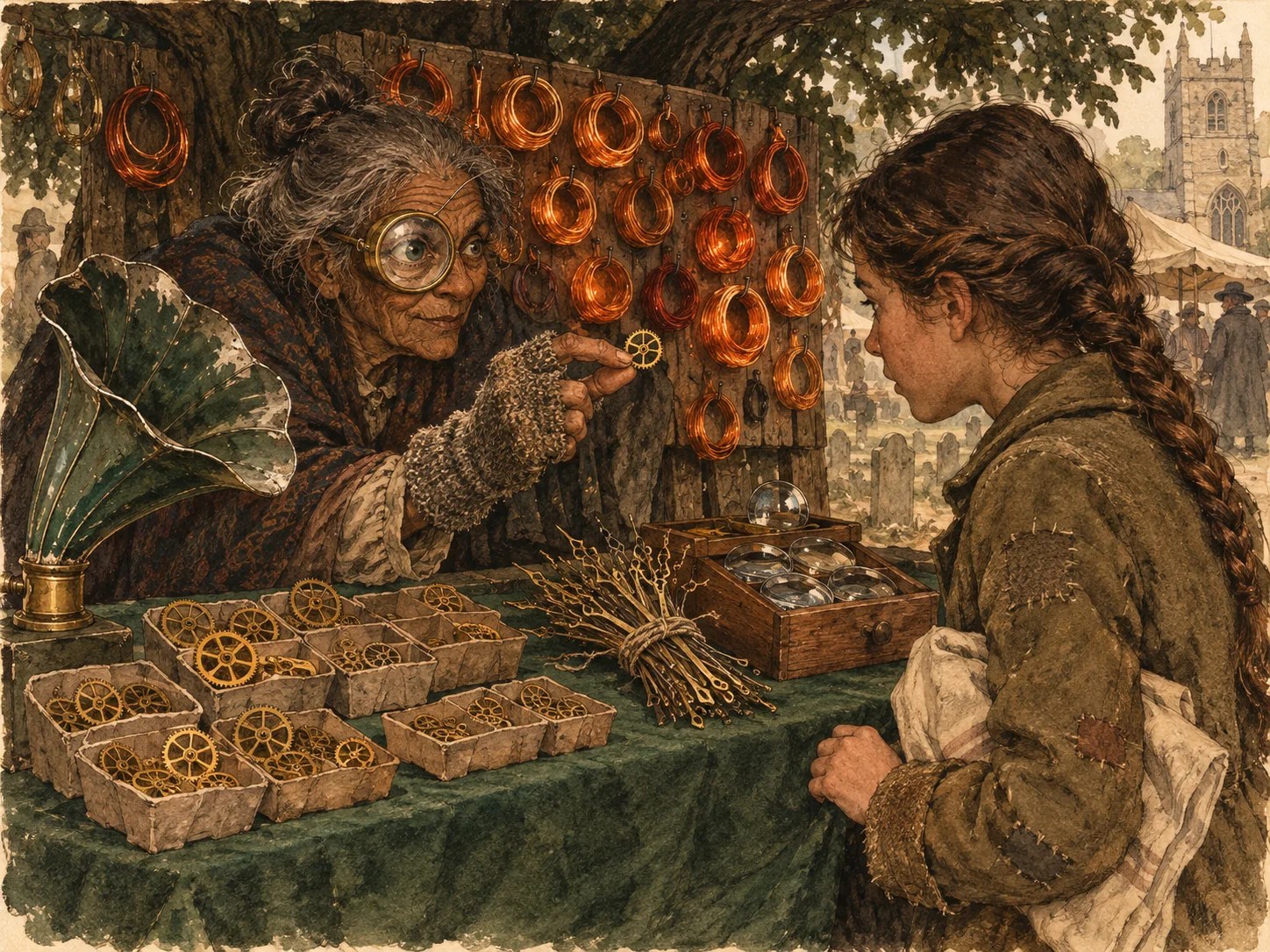
It was a horn. Tin, dark green once, the paint chipped back to bright metal round the lip, flaring from a narrow brass collar like a lily that had opened too far. Somebody had trodden on it, years ago, and the folded seam had sprung for a hand’s length down one side.
“Margula’s box has a brass trumpet that rings like a parish bell,” said Sallow. “That’s why her wax sounds like the inside of a pan. Leave this split and it rattles. Put a hot iron to it and it sings back at you. Dead to its own note if you wax it, girl, not solder it.”
Then a twist of brown paper, very small, sealed with a dab of red wax, laid on top of the horn.
“Number forty. For your green man’s beehives.”
“What do bees want with wire?”
“Ask him. He’ll tell you something. He always does.” She screwed the glass back into her eye and was a jeweller again, enormous and uninterested. “Margula’ll hear the teeth the first time she winds it. Borrowed teeth click brighter. Go on. Your eels are crying.”
The eels leaked the whole two hours.
They leaked through three thicknesses of the Courier into the side of her skirt, and Bracken walked the whole way up the forest road with his nose against the patch. He walked into her, on the diagonal, steadily, so that every twenty paces his shoulder came against her shins and she had to step sideways not to go over. She told him. He gazed up with tremendous sincerity and did it again.
She nearly dropped the horn twice. Once on the bridge, which she took going back because her legs had had enough of stones, when he leaned at the wrong moment and she had to choose between the horn and the eels. And once on the steep ruts below the forestry post, where a root caught her toe and the horn went up out of her hand and came down again, by some kindness of somebody’s, into her arms.
The oat-husk came out at the orchard gate. She sat on the gatepost and unlaced the boot to the toe and there it was, pressed flat into the shape of her heel, thin and gold as a coin.
Isaac was in the pear loft under the roof, cross-legged on the slats with the last of the old year’s pears, with the brass box open beside him on a sack. Bracken stayed at the bottom of the ladder with his front feet on the first rung, offended, because he had never forgiven anybody for ladders.
“Sallow sent you this,” Aria said, and gave him the twist of paper first, before she could change her mind about anything. “For the beehives.”
Isaac took it between finger and thumb. The green light at his temple stayed exactly as it was.
“How thoughtful of her. The weighing pans under the skeps have a coil in them. It tells me when a hive is heavy with honey, and when it is light because something has been robbing it. The old coil has worn thin.” He put the twist in the pocket of his grafting apron. “Edison said there is a better way to do everything.”
“I broke Margula’s box.”
“It has been on the dresser since Tuesday with its back plate on crooked.” He took the governor, listened to it once, gave the three-note sound again, lower, and fitted it back into the train in less time than it took her to sit down.
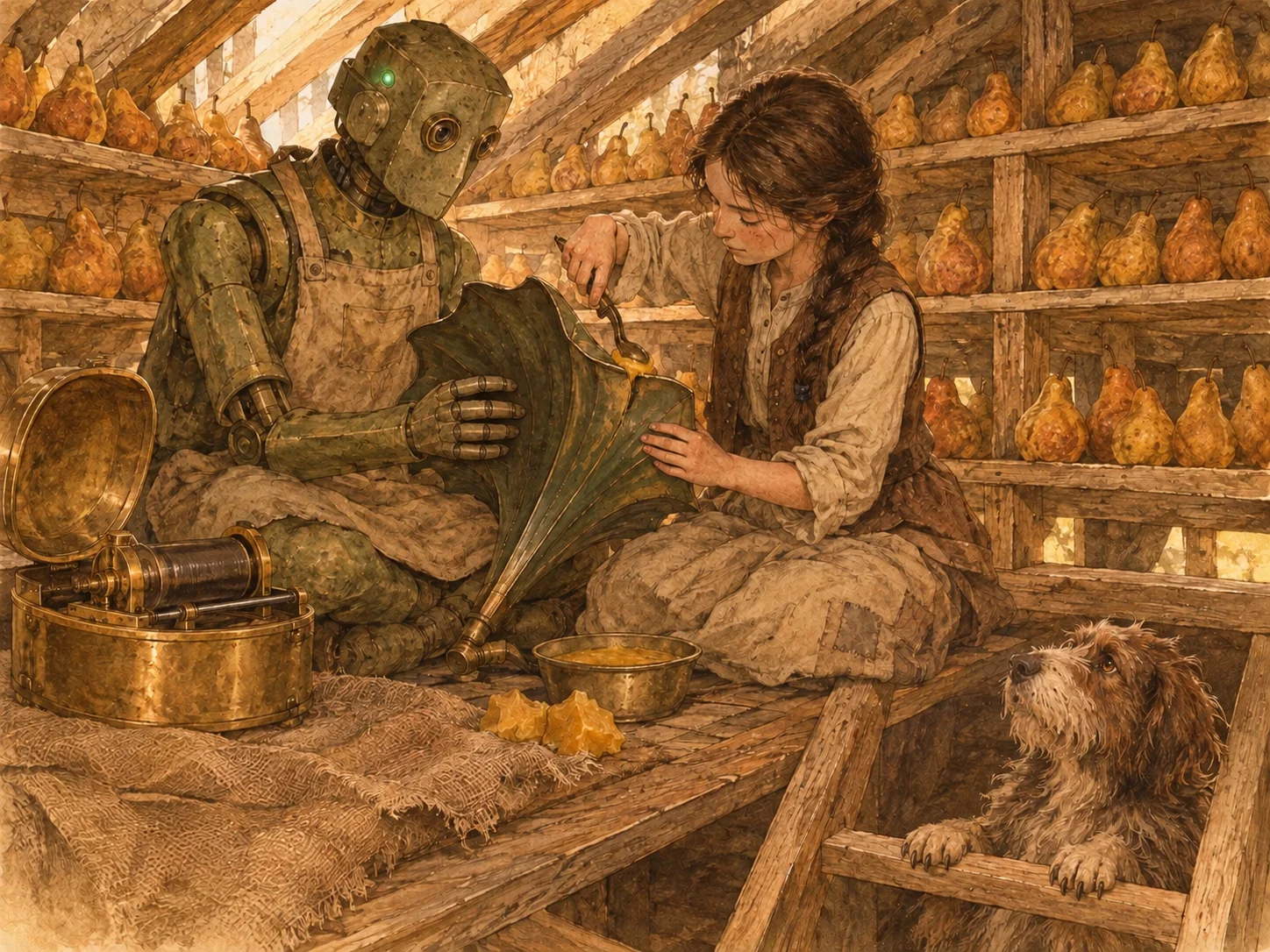
Then they did the horn. He took a lump of yellow comb-wax from the jar on the beam and held it in the cup of his hand, and after a while a smell of warm metal and hot dust came off his wrist and the wax went soft and clear at the edges like honey in sun. She worked it into the sprung seam with the back of a horn spoon while he held the tin true from inside with two fingers. It took most of an hour. Halfway through, far up the valley where the beeches closed over the Long Path, the drummers started again. Three and a trip and three.
“They never do fours,” she said. “Why? Down the valley it’s all fours. Skipping ropes by the trough. The chapel bell. The children clapping the Register Song in rows by the pump. The top drummer kept crowding the middle trip half a breath early, pushing, like he wanted the other one off the dead limb.”
“Fours are very good if you want forty people to put their left boots down on the same cobble,” said Isaac. “If you are one bird in a thick wood with the wind in it, and you want to know whether that knock was your partner or a beechnut falling, a stumble is much harder for a beechnut to copy.”
She flicked the mended lip with her fingernail. It went thup, a short dry cup of air, and nothing after.
Margula found out at supper, which was eels. She wound the box at the table to see why it had a green tin horn on it, and at the seventh click she stopped with the key between her fingers, and wound once more, and listened.
“Sallow’s teeth.”
“Seven.”
Margula wound to twenty-four, exactly, and set the key down. “Then you can walk her next sack down. And the one after. And the eels come out of your own tin, because I said twice and you paid for three.” She rapped the mended green rim once with her fork handle and laid two fingers along the waxed seam to feel whether it buzzed. Nothing sang back. “That’s a better horn than mine,” she said. “The two sacks stand. So do the eels. Scrape the salt off that skirt before it rots the hem.”
The Grandmother stood above the bend of the Long Path where the beeches were oldest, and in the hour before dawn there was no light under her at all.
No beech on the hill came near her. Margula said she and Isaac and a forester from the post had once tried to go round her fingertip to fingertip and been a whole arm short, and the forester had blamed Isaac for not stretching. Her bark went up into the dark grey and smooth and cold as a wall. Aria found the strap by feel. She packed a pad of folded moss behind the back plate, thick as a loaf, because every drummer and woodpecker on the trunk would come straight down through the wood into the brass and drown whatever the horn caught. She buckled the box to the tree at the height of her chin with the green lily mouth turned out over the valley.
Twenty-four clicks. She counted them under her breath, and seven of them came brighter.
Then she sat in last year’s mast with her back to the Grandmother and Bracken across her feet, and waited for the grey.
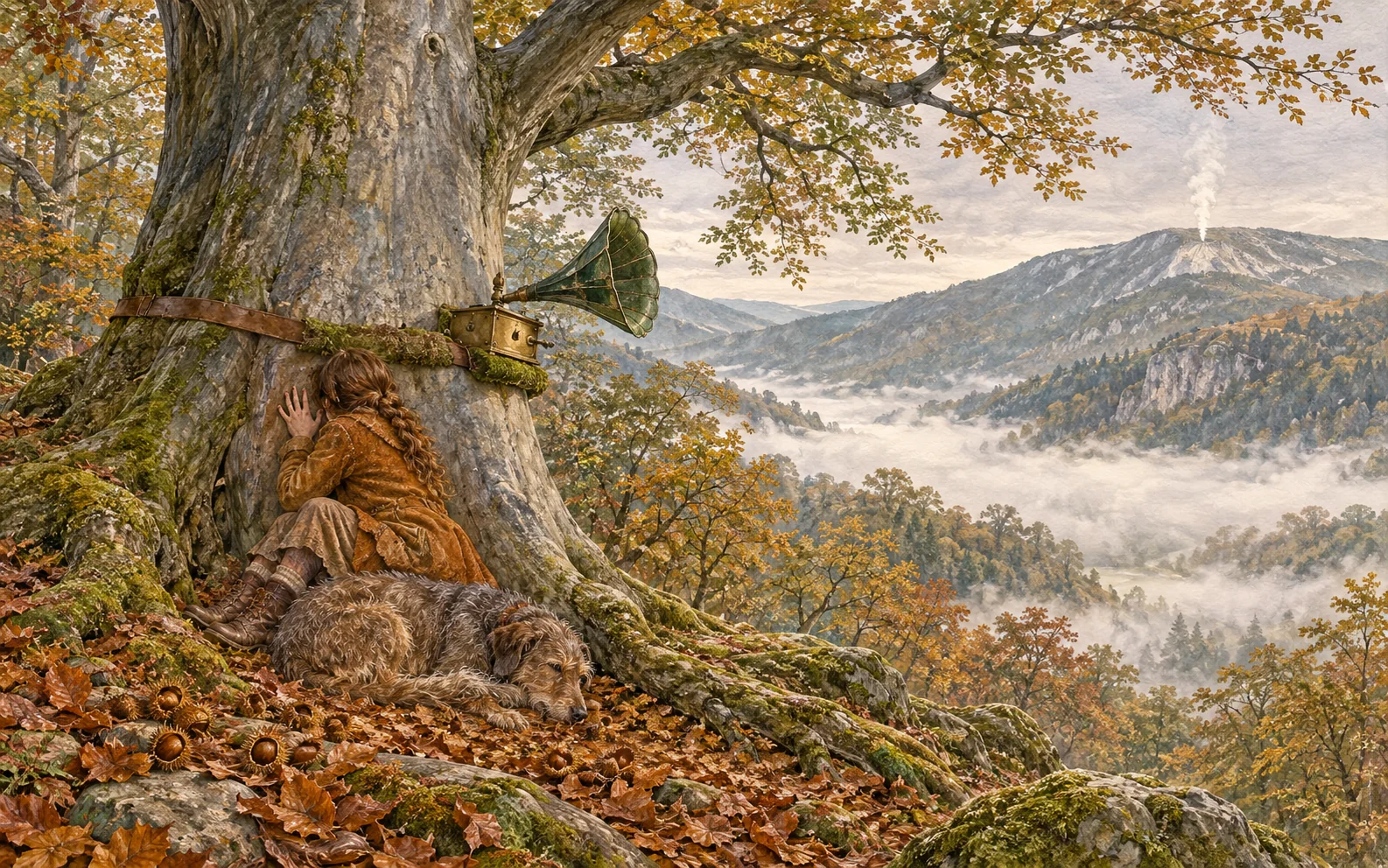
It came up out of the valley slowly, with the mist lying in the bottom like milk in a bowl. When she could see her own hands she let the needle down onto the wax, and the box began, very faintly, to turn.
First the stream, which had been going all night and didn’t care. A wood pigeon saying the same thing five times in case nobody had heard. Far down the valley, thin and clear, the bell at the forestry post ringing the dawn watch in fours, and after it, fainter, the Office drum at Hollow Ford beating the morning drill. Four and four and four. The Breathing Stone’s plume going up white over the treetops, which made no sound.
Then the drummers, low on the rotten limbs and high in the canopy, threes, every pair its own, with the trip in the middle that the Long Path always had.
And under all of it, something she had not come for.
It was slower than the birds. A knock, and a long gap, and a knock that came a little early, as if whatever made it had stumbled and caught itself. It came up through the mast and through the bark into her shoulder blades, and she could not tell whether it was in the wood or in the air, or whether the horn could hear it at all.
She kept still. The bell in the valley rang its fours, and the drum beat its fours, and the crooked knock came up out of the ground beneath them without hurrying, without once falling into step, as if it had been keeping its own time a great while before anybody thought to count.
At the end of the fourth minute the needle lifted off the wax by itself. Aria stayed where she was, with her ear against the Grandmother, and counted, and lost count, and started again.