An Eye Where an Eye Should Not Be
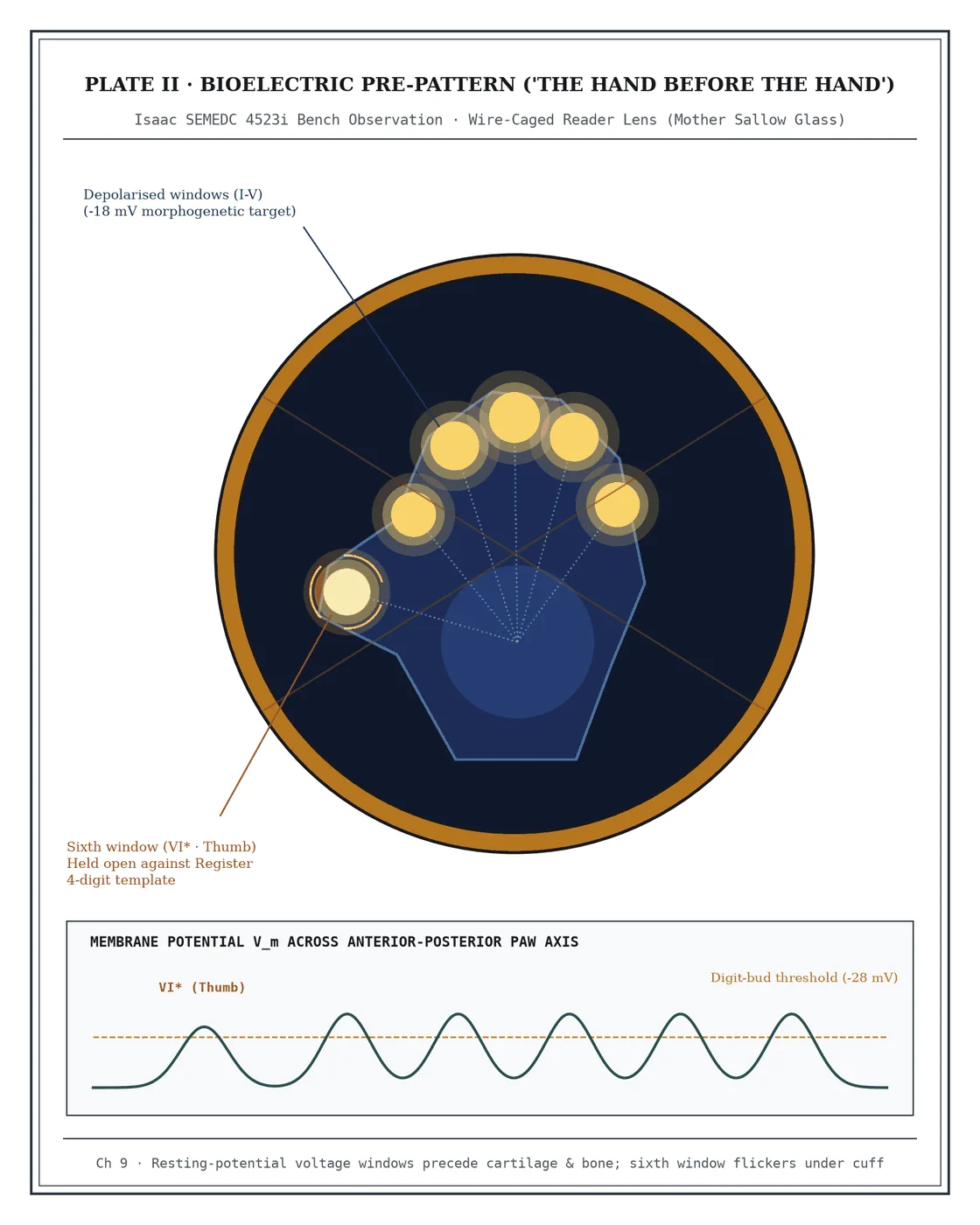
Here is an experiment that sounds like a story from Ilun and is not. In 2012, in Michael Levin’s laboratory at Tufts University, Vaibhav Pai and colleagues changed the electrical charge across the membranes of a few cells in a frog embryo, far from where the head forms. Those cells went on to build eyes: complete, layered eyes, sometimes on the tadpole’s gut or tail.1 No gene for “eye” had been edited. The researchers had changed a voltage pattern, and the body read that pattern as an instruction.
Levin’s argument is that every cell, not only nerve cells, keeps a small electrical difference between its inside and outside, and that tissues use these differences to share a map of the body they are building.2 His team has cut flatworms in half and, by briefly altering that map, produced worms with two heads that keep growing two heads every time they are cut again, generation after generation, with their DNA untouched.3
Book I takes one large step beyond the laboratory. Ilun’s wild animals have six toes. The Concord found that unsettling, and instead of rewriting the animals’ genes it learned to clamp an electrical signal before birth, so the sixth toe never forms. The genes are still there, waiting. That is why the soft grey cuff Isaac fits to a small six-toed creature in the Snug matters so much: it suggests the clamp can be lifted, and that what was folded away was never erased.
Why Five Is an Accident
Count your fingers and you will probably get five, and it is easy to assume five is what a hand is. The fossils disagree. Acanthostega, a creature from about 365 million years ago that lived in shallow water, had eight digits on each front limb, and its relative Ichthyostega had seven on its hind limbs.4 Five won later, more or less by accident, and has stuck.
Even now, the count wobbles. Ernest Hemingway’s house in Key West is still home to dozens of cats, many with six or seven toes, descended, the story goes, from a ship’s cat given to him by a sea captain. Their extra toes come from a tiny change in a stretch of DNA that switches on a growth signal called Sonic hedgehog in the developing paw. Alan Turing, better known for code-breaking, proposed in 1952 that repeating patterns such as stripes, spots and perhaps digits could arise from two chemicals spreading and reacting.5 Biologists now model the spacing of fingers in a similar way: change the size of the paw or the timing of the signal, and you change how many stripes of bone fit inside.
So the series makes digit count a kind of passport. Six on Ilun’s wild animals, which nobody clamped. Four on the Register’s licensed sheep and dogs, like Margula’s old dog Bracken. Five on humans and the humanoid machines. And on Carthago, far later, the native walkers have no jointed digits at all, only three soft pads arranged in a circle.
Spearmint, Caraway & a World Built Backwards (Books III–IV context: Carthago’s mirror-handed felt and what the colony can safely eat)
Spearmint, Caraway & a World Built Backwards
Chew a spearmint leaf, then a caraway seed. You are tasting the same molecule, carvone, in its two mirror forms. The atoms are identical; one version is simply the other’s reflection, the way your left glove is the reflection of your right. Your nose can tell them apart because the receptors in it are handed too.
Almost all life on Earth uses one hand. Our proteins are built from left-handed amino acids; our sugars are right-handed. Nobody is quite sure why, though there are good theories about how a small early bias could have been amplified.6 In December 2024 a group of leading scientists wrote in Science urging the world not to build “mirror bacteria”, because a mirror microbe might slip past immune systems and predators that only recognise our hand.7
Carthago is a whole planet of the other hand. Its felt, its fronds and its walkers are rich, green and alive, and much of it is useless or worse to a human stomach. The colony survives by slow, careful testing and by finding the narrow places where barley and native life can share the same rain without poisoning each other. The biology here is the same rule as the politics: you do not get to assume that the world was built for you.
Handedness is everywhere once you look. The DNA in every cell of your body twists the same way, like a right-handed screw, and nearly all the amino acids in your proteins are the left-handed version. Nobody knows for certain why early life on Earth picked one hand and stuck with it. It is one of the reasons a world with life of its own might be built from the other half of the mirror, and why Book III treats “will it poison us?” and “will we poison it?” as one question.
Held, Not Written (Books I–III context: what was done to Nefer’s flush, and how a clamp differs from a rewrite)
Held, Not Written
A blush is plumbing as well as feeling. Signals from the sympathetic nervous system widen tiny blood vessels in the cheeks, ears, neck and upper chest, and warm blood rushes in. Most of that wiring runs automatically, below the level of the will.
In High Concord, the children of rank are conditioned so that the signal is caught before it reaches the skin. In Book III a kind man who lives among clocks tells Nefer, at seventeen, that her silence is held, not written. The feeling was never removed. Something is holding a door shut on it, all the time, the way a voltage pattern in Levin’s flatworms keeps telling the tissue “two heads” until somebody changes it.
A clamp that must be held can, in principle, be let go. That is the hope the books keep alive for her. They are equally stubborn about the rule attached to it: nobody gets to release the clamp for her. Whether the door opens, and when, has to be her decision.
Primary Sources & Scholarly References (Hover or tap superscripts inline to preview)
- Vaibhav P. Pai et al., “Transmembrane voltage potential controls embryonic eye patterning in Xenopus laevis”, Development 139:2 (2012), 313–323, PMC3243095.
- Michael Levin, “Bioelectric signaling: Reprogrammable circuits underlying embryogenesis, regeneration, and cancer”, Cell 184:8 (2021), 1971–1989, Cell.
- Fallon Durant et al., “Long-Term, Stochastic Editing of Regenerative Anatomy via Targeting Endogenous Bioelectric Gradients”, Biophysical Journal 112:10 (2017), 2231–2243, PMC5443808.
- M. I. Coates and J. A. Clack, “Polydactyly in the earliest known tetrapod limbs”, Nature 347 (1990), 66–69, Nature.
- Alan M. Turing, “The Chemical Basis of Morphogenesis”, Philosophical Transactions of the Royal Society B 237 (1952), 37–72, Royal Society Publishing.
- Donna G. Blackmond, “The Origin of Biological Homochirality”, Cold Spring Harbor Perspectives in Biology 2:5 (2010), PMC2857173.
- Katarzyna P. Adamala et al., “Confronting risks of mirror life”, Science 386:6728 (2024), 1351–1353, Science.