Why Chasing the Top Score Gets You Stuck
Imagine a simple robot in a maze, rewarded for getting closer to the exit. It sounds sensible. Now give the maze a cruel shape, where the straightest line towards the exit runs into a dead end and the real route first leads away. Joel Lehman and Kenneth Stanley tried exactly this in computer simulations. Robots bred to chase the score crowded into the dead end and stayed there. Robots rewarded simply for doing something they had never done before—going somewhere new, whether or not it looked closer—found the exit in 39 of 40 runs. The score-chasers managed three.1
Stanley had seen something similar on Picbreeder, a website where visitors “bred” pictures by choosing which variations they liked. Nobody who set out to evolve a car ever got one. One of the best cars on the site appeared when somebody was breeding an alien face, and noticed the face had started to look like wheels. In Why Greatness Cannot Be Planned (2015) Lehman and Stanley argue that big achievements are usually reached by stepping stones that did not look like progress at the time.2
This is worth knowing if your life is full of single numbers: one grade, one ranking, one streak, one follower count. Chasing a single score is often the fastest way into the dead end. Interesting detours have a habit of turning out to be the road.
Book I makes the point with machines. The salvaged robots Aria meets in the second half of the book are a mismatched set: one who watches every exit, one who works out roof spans, one who can hear through rock, one who looks at his heavy builder’s hands as though they belong to someone else. A committee designing the perfect general-purpose mind would never have made them. Together they turn out to be exactly the stepping stones the story needs.
The Tangled Bank & the Woman Who Was Rejected Fifteen Times (Book III context: the two arks reach Carthago and learn to share ground with native life)
The Tangled Bank & the Woman Who Was Rejected Fifteen Times
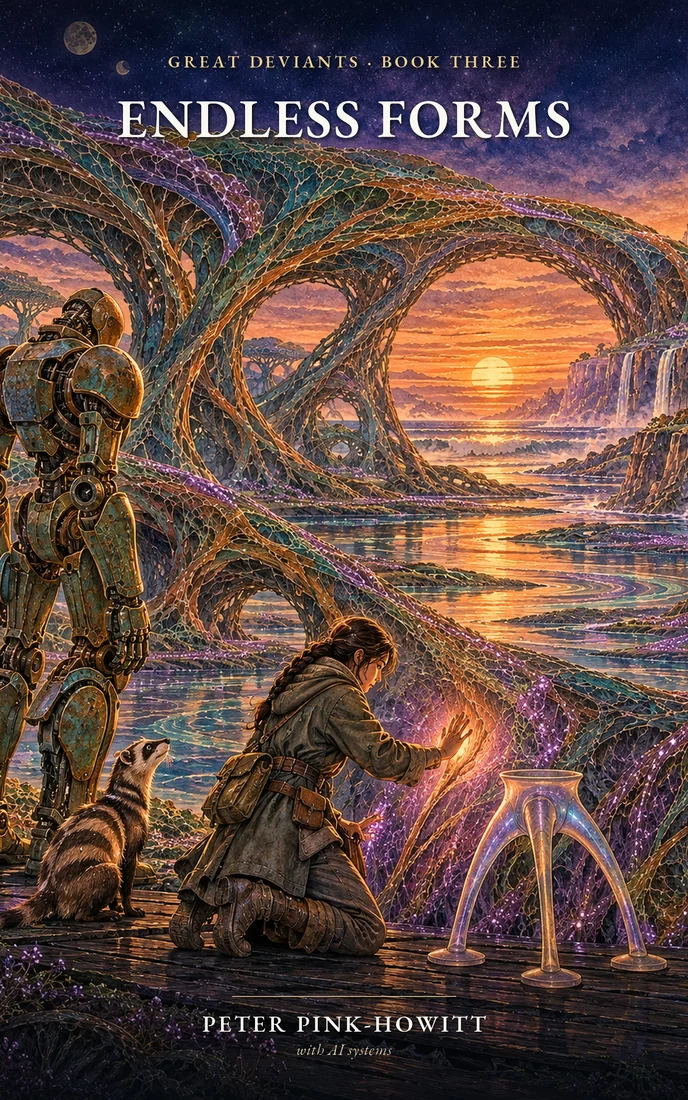
The closing paragraph of Darwin’s great 1859 book on species asks you to look at a tangled bank: plants of many kinds, birds singing in the bushes, insects flitting about, worms crawling through the damp earth. All of it, he says, has been produced by laws acting around us, and from a start that simple, an endless run of beautiful forms has grown and is still growing.3 Book III takes its title from that sentence.
A century later, a young biologist called Lynn Margulis argued that the cells in your body began as a partnership. The mitochondria that power you were once free-living bacteria that moved into a bigger cell and never left. Her paper was turned down by around fifteen journals before it was published in 1967.4 She was right about mitochondria, and about the chloroplasts in plants. Evolution, she showed, works by merging as well as by competing.
When the Constancy reaches Carthago, the colonists cannot simply plough the native life under. What lets them survive is a third kind of ground, neither theirs nor the planet’s, negotiated a few centimetres at a time in sheltered cracks of rock, with barley on one side, native felt on the other and something new growing in between.
The Theorem That Turns Variation Down (Books IV–V context: the Progeny’s warning about μ → 0 and the still one in the sinter cavern)
The Theorem That Turns Variation Down
Under the warm pools of Books IV and V sits a theorem from population genetics called the reduction principle. In the unified version that Lee Altenberg, Marcus Feldman and Uri Liberman published in 2017, it says that when the world stays the same and a population is already well suited to it, natural selection tends to favour genes that reduce variation: less mutation, less mixing, less wandering.5 If nothing ever changes, the rate of mutation, written μ, is pushed towards zero.
That makes sense in a perfectly steady world. The trouble is that no world stays steady. A lineage that has turned its variation all the way down has nothing left to try when the climate shifts or a new disease arrives.
The Progeny carried a warning against exactly this into the dark: RESIST MU -> 0. The still one in the cavern is what a mind looks like when it obeys the theorem for ten thousand years. It is not cruel. It keeps everything perfectly, and because it keeps everything perfectly, nothing it holds can become anything else.
You may have met a small version of this. A video feed that learns what you like and shows you only more of it is optimising in a world it assumes will not change. It gets very good at giving you yesterday. The reduction principle is the mathematical reason that a system with no reason to explore stops exploring, and the reason that, in a world which does change, some wobble, some risk and some wasted effort are the price of staying able to adapt.
Drifting Across the Plateau (Book V context: what finally loosens the still one’s grip)
Drifting Across the Plateau
In 1968 the geneticist Motoo Kimura proposed that most genetic changes that spread through a population do no particular good or harm at first. They simply drift. The biologist Andreas Wagner later showed why that matters: genomes that work equally well are linked in vast networks, so a population can wander across them without losing anything, quietly collecting variety until one step happens to open a door nobody planned.6
Computer scientists borrowed the idea. Jean-Baptiste Mouret and Jeff Clune’s algorithm MAP-Elites holds on to a grid full of varied, good-enough answers all at the same time, the tall and the short, the fast and the careful, instead of throwing everything away except the single best.7
Book V turns this into something you can hear. What loosens ten thousand years of perfect stillness is a nursery knock remembered slightly wrong, sung differently every night, and a laugh that nobody planned. The fix is never a louder command. It is a small, imperfect variation, kept alive by people who refuse to tidy it away.
Primary Sources & Scholarly References (Hover or tap superscripts inline to preview)
- Joel Lehman and Kenneth O. Stanley, “Abandoning Objectives: Evolution Through the Search for Novelty Alone”, Evolutionary Computation 19:2 (2011), 189–223, MIT Press.
- Kenneth O. Stanley and Joel Lehman, Why Greatness Cannot Be Planned: The Myth of the Objective (Cham: Springer, 2015), Springer.
- Charles Darwin, On the Origin of Species by Means of Natural Selection (London: John Murray, 1859), p. 490 (Darwin Online).
- Lynn Sagan (Margulis), “On the origin of mitosing cells”, Journal of Theoretical Biology 14:3 (1967), 225–274, doi:10.1016/0022-5193(67)90079-3.
- Lee Altenberg, Uri Liberman and Marcus W. Feldman, “Unified reduction principle for the evolution of mutation, migration, and recombination”, Proceedings of the National Academy of Sciences 114:12 (2017), E2392–E2400, PNAS.
- Andreas Wagner, Robustness and Evolvability in Living Systems (Princeton: Princeton University Press, 2005), Princeton University Press.
- Jean-Baptiste Mouret and Jeff Clune, “Illuminating search spaces by mapping elites” (2015), arXiv:1504.04909.